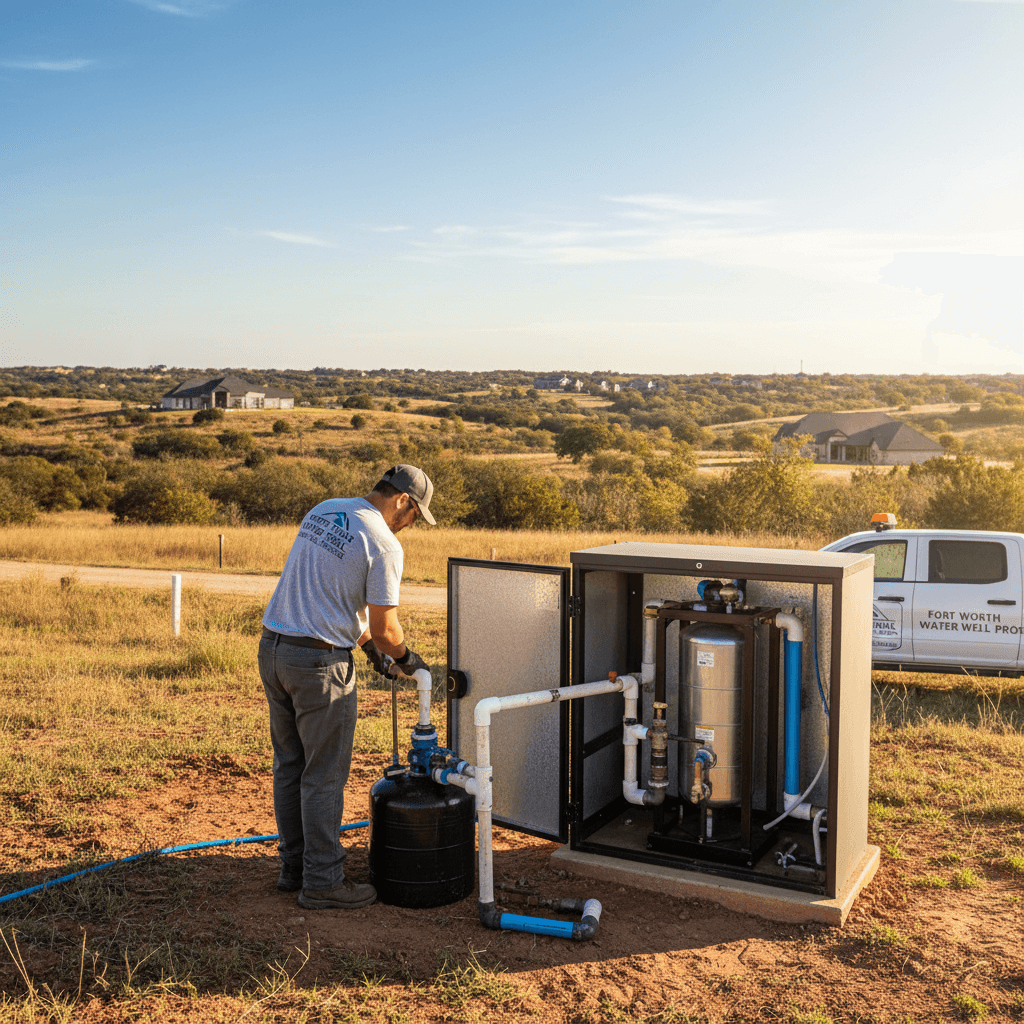
How to Choose the Right Well Water Pump
Choosing the right well water pump depends on four things: how deep your well is, how much water your household uses daily, the water chemistry in your area, and whether you're replacing an existing pump or starting from scratch. Get any one of these wrong and you'll either have a pump that can't keep up with demand or one that burns out in two years instead of fifteen.
This guide covers everything a North Texas homeowner needs to know — from pump types to sizing to the specific considerations that matter in the Fort Worth, Parker County, and DFW area.
Quick Answer: What Type of Well Pump Do You Need?
- Well under 25 feet deep: Shallow well jet pump
- Well 25–90 feet deep: Convertible (deep well) jet pump
- Well over 90 feet deep: Submersible pump — this is most North Texas wells
- Very high demand or multiple buildings: Booster pump added to existing system
Most residential wells in the Fort Worth area — particularly those tapping the Paluxy or Trinity aquifers — run between 200 and 800 feet deep. That means nearly every DFW-area homeowner needs a submersible pump.
The 4 Factors That Determine Which Pump You Need
1. Well Depth
Well depth is the single most important variable in pump selection. It determines the pump type, the motor horsepower required, and the cable length needed to reach the pump.
- 0–25 feet: Shallow well jet pump (rare in North Texas — aquifers are much deeper)
- 25–90 feet: Convertible jet pump or submersible
- 90–400 feet: Submersible pump, typically 1/2 to 1 HP
- 400–800+ feet: Submersible pump, typically 1 to 2 HP depending on depth and demand
In Parker County and Wise County, Paluxy aquifer wells commonly run 200–400 feet. Trinity aquifer wells in Denton County and southern Parker County often go 400–750 feet. If you don't know your well depth, it should be on your original well completion report — or we can measure it during an inspection.
2. Flow Rate (GPM) Required
GPM — gallons per minute — determines whether your pump can keep up with household demand. The general rule is 1 GPM per fixture, but the practical calculation is:
- 1–2 people, minimal irrigation: 5 GPM minimum
- 3–4 people, average household: 7.5–10 GPM
- 5+ people or irrigation system: 10–15 GPM
- Livestock or agricultural use: 15–25+ GPM depending on head count
Most submersible pumps are rated at 5, 7.5, 10, or 15 GPM. Don't buy a 5 GPM pump for a 4-bedroom house with a lawn — you'll be pulling the pump in 5 years instead of 15 because it never stops running.
3. Total Dynamic Head (TDH)
TDH is the total pressure the pump must overcome to deliver water at your tap. It includes the static water level, pumping draw-down, pipe friction losses, and your pressure tank requirements (typically 40–60 PSI for residential systems). A professional pump installer calculates TDH before recommending a motor size — this is why "I just need a 1 HP pump" isn't a complete answer. Two 1 HP pumps at the same depth can have completely different performance curves.
4. Water Chemistry
This gets ignored by homeowners and hardware store advice alike. Water with high iron, mineral hardness, or hydrogen sulfide is corrosive to pump components. Without treatment upstream, you're looking at 5–7 year pump life instead of 12–15 years. For iron-heavy water common in Parker and Wise counties, look for pumps with stainless steel casings and impellers — and pair the pump with a filtration system to protect the pump and every fixture downstream.
Submersible vs. Jet Pump: The Practical Differences
Submersible Pumps
The motor and pump are sealed together and submerged in the water at the bottom of the well. Because the pump pushes water up rather than pulling it, submersibles are far more efficient at depth and can lift water from much deeper wells.
Pros: Works at any depth, quiet (underground), more efficient, longer service life when properly sized
Cons: Requires pulling the pump from the well for service — a job for a licensed installer, not a DIY project
Jet Pumps
Mounted above ground, jet pumps work by creating suction to pull water up from the well. They're limited to around 25 feet of suction lift — deep well jet pumps use an ejector assembly to extend effective depth to around 90 feet.
Pros: Accessible for maintenance, easier to service
Cons: Limited to shallower wells, less efficient, louder, more susceptible to freezing
In the DFW area, nearly every well is deep enough to require a submersible. If someone recommends a jet pump for a 300-foot Parker County well, get a second opinion.
Pressure Tanks: The Part Everyone Forgets
Your pressure tank stores pressurized water so the pump doesn't cycle on every time you open a faucet. A properly sized pressure tank reduces pump start cycles from hundreds per day to 10–20, extends motor life significantly, and maintains consistent pressure. If you're replacing a pump, always check the pressure tank. A waterlogged tank causes short-cycling — the #1 cause of premature pump failure we see in the field. Replacing both at the same time while the well is already open saves a service call later.
Signs You Have the Wrong Pump or a Failing Pump
- Pressure drops mid-shower or when the dishwasher runs
- Pump runs constantly and never shuts off
- Pump short-cycles (on/off every few seconds)
- Water pressure is fine for the first minute, then drops sharply
- Electric bill increased without explanation
- Air sputtering from faucets
Short-cycling in particular burns out motors fast — what could have been a pressure tank replacement becomes a full pump pull if ignored for a season. Call us for a free inspection if you're seeing any of these.
Frequently Asked Questions
How long does a well pump last in North Texas?
A properly sized submersible in average water conditions lasts 12–15 years. In iron-heavy water common to Parker, Wise, and Hood counties without filtration, expect 6–10 years. Oversized or undersized pumps wear out faster regardless of water quality.
Can I install my own well pump in Texas?
No. Texas law requires all well pump installation and replacement to be performed by a TDLR-licensed Water Well Pump Installer. Unlicensed pump work can void your homeowner's insurance and create aquifer contamination liability.
What size pump do I need for a 400-foot well?
At 400 feet with a typical static water level of 250–300 feet, most residential homes need a 1 HP submersible rated for 7.5–10 GPM. The exact spec depends on your actual static level, drawdown rate, and household demand — which is why a site evaluation matters before purchasing.
Why is my new pump not building pressure?
Most likely cause: the pressure tank is waterlogged, the pressure switch is set incorrectly, or there's an air leak in the drop pipe. Start by checking the pressure tank bladder with a tire gauge on the Schrader valve (pump off, system depressurized). Normal pre-charge is 3–5 PSI below your cut-in pressure.
Is a 1/2 HP pump enough for a residential well?
For wells under 150 feet with a static water level above 100 feet and light demand, yes. For most DFW-area wells — which commonly run 200–500+ feet — 3/4 to 1 HP is more appropriate. Undersizing is a common mistake that leads to premature motor failure.
How do I know if I need a submersible or jet pump?
If your well is deeper than 90 feet, you need a submersible. In the Fort Worth metro and surrounding counties, nearly all residential wells exceed 90 feet — most are 200–500+ feet. Jet pumps are primarily used in older, shallower wells in other regions.
Legacy Water Well installs and services well pumps throughout Fort Worth, Parker County, Wise County, Hood County, and surrounding North Texas counties. We evaluate your well depth, water chemistry, and household demand before recommending a pump — not after. Well pump installation | Well pump repair | Submersible pump service | Get a free estimate.